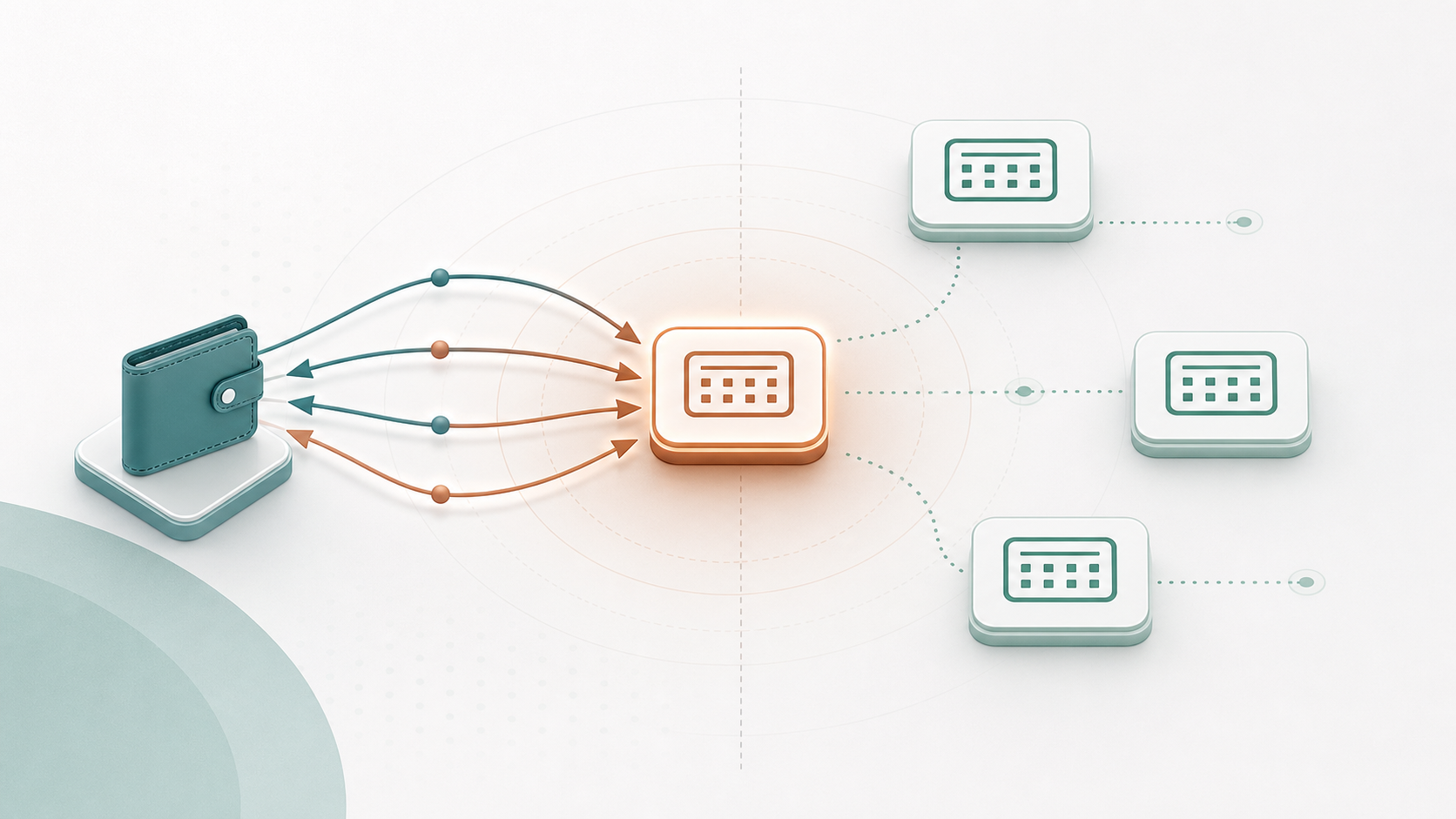
Privacy by default in a crypto wallet means the wallet's normal flow should help you expose less public information by mistake. It is not an anonymity mode, a product category, or a promise that your transactions cannot be traced.
In practice, privacy by default means fresh receive addresses where that makes sense, separate accounts or wallets for separate contexts, clear labels, and warnings that help users avoid reusing the wrong public identifier. These defaults reduce avoidable linking, but they do not erase public-chain history or make crypto private by default on its own.
The Short Answer
A privacy-by-default wallet should make safer privacy habits the easy path. On Bitcoin-style wallets, that often means showing a fresh receive address for new payments. On Ethereum-style account wallets, it may mean helping users separate activity by account, purpose, or network instead of treating one account address as the default place for everything.
The goal is not to hide wrongdoing or defeat obligations. The goal is to avoid unnecessary oversharing. A person paying one invoice, sending one donation, or interacting with one app usually does not need an easy view into every other public activity connected to the same address.
Good wallet defaults should always come with honest limits. Fresh addresses, separate accounts, and labels can reduce obvious links. They do not make a transparent blockchain anonymous, remove records from counterparties, or stop all forms of blockchain analysis.
What Privacy By Default Should Mean
Privacy by default starts with a simple design question: if a normal user clicks through the ordinary wallet flow, does the wallet help them avoid exposing more than they intended?
For receiving funds, that may mean the wallet avoids encouraging one permanent receive address for every payment. For account management, it may mean the wallet makes it easy to create, name, and recognize separate accounts for different purposes. For transaction history, it may mean labels and warnings that help users understand when they are about to mix contexts.
This matters because public-chain activity is designed to be inspectable. A public address does not reveal your private key, but it can reveal visible activity associated with that address. If the same address is used for friends, clients, public donations, exchange withdrawals, and app interactions, those contexts can become easier to connect.
Privacy by default should reduce that accidental linking. It should not make users study wallet architecture before they can avoid the most obvious mistakes.
Wallet, Account, And Address In Plain English
A wallet is the software, device, or key structure you use to manage crypto. People often use "wallet" casually to mean the app on their phone, the hardware device on their desk, the recovery phrase behind it, or the whole place where they see their funds.
An account is a grouping inside a wallet. MetaMask's multichain account documentation describes a wallet as a cluster of accounts controlled by a source of keys, and an account as a collection of addresses from different networks within that wallet. Other wallets may present the model differently, so this is a useful example rather than a universal definition.
An address is the public network-specific identifier used to receive funds or interact with a blockchain. On Ethereum, an externally owned account can hold ETH and tokens, send transactions, and interact with smart contracts. On Bitcoin-style wallets, one wallet can commonly manage many receive addresses.
The practical privacy lesson is the same across models: do not assume one public identifier should be used for every context. Whether the wallet calls it an address, account, or wallet, the question is what public history someone can connect to it.
Fresh Receive Addresses For Bitcoin-Style Flows
Bitcoin.org's privacy guidance says Bitcoin transactions are public, traceable, and permanently stored on the network. It also recommends using a new Bitcoin address each time you receive a payment. That is the classic example of a privacy-by-default wallet flow.
Trezor's support guidance explains the same user-facing point: reusing a Bitcoin receive address can let people inspect transactions involving addresses they learn about, so Trezor Suite generates fresh Bitcoin-style receive addresses. The important detail is that this is normal wallet hygiene, not a sign that the old address disappeared or that a new wallet was created.
Imagine you use one address for a public donation page, a client invoice, a friend's payment, and a later app interaction. Anyone who sees that address may be looking at the same visible public history. If your wallet gives you fresh receive addresses for separate payments, each sender gets the address they need without automatically receiving the same public index into other contexts.
Fresh receive addresses have limits. Later spending behavior, combined funds, exchange records, public posts, app activity, and counterparties can still add links. Fresh addresses reduce simple address reuse; they do not make activity invisible.
Separate Accounts Or Wallets For Separate Contexts
Ethereum-style accounts often feel different from Bitcoin-style receiving flows. An Ethereum account address can become the visible center for balances, token transfers, approvals, app interactions, NFTs, and smart-contract activity. If one account is used everywhere, it can start to behave like a public profile.
That does not mean every user needs a complicated setup. It means wallet defaults should make context separation understandable. A user might keep one account for public donations, another for client invoices, and another for personal app activity. The separation does not create anonymity, but it avoids making one address the obvious place where every context meets.
Separate wallets can also help when the contexts are truly different, such as long-term storage versus frequent app use. The tradeoff is operational complexity. More accounts and wallets mean more labels, more careful checking, and more chances to send from the wrong place if the interface is unclear.
That is why privacy by default is also a usability problem. The wallet should make separation easy enough to maintain, not so confusing that users give up and reuse one address for everything.
Labels, Account Names, And Warnings Are Privacy Features
Labels do not change the blockchain. They change whether future-you can make a good decision.
If an account is named "client invoices," "public donations," or "personal app testing," you are less likely to reuse it in the wrong place later. If a transaction is labeled, you may better understand which funds are connected to which context before spending or moving them. The Bitcoin Security Guide treats labels as part of practical privacy hygiene because they help users avoid accidental links later.
Good warnings matter for the same reason. A wallet can warn before reusing a receive address, before sending from an account that has a public profile, or before combining activity that the user has tried to keep separate. The warning does not need to sound scary. It just needs to say what public link may be created.
The best default is a calm interface that helps users remember context. Privacy often fails not because the user wanted to overshare, but because every account, address, and transaction looked interchangeable.
What Wallet Defaults Cannot Solve
Wallet defaults cannot make a public blockchain private by themselves. Public transaction history can remain visible. A block explorer may show balances, transfers, tokens, app interactions, timing, and relationships depending on the chain and the address.
Wallet defaults also cannot control every off-chain record. Exchanges, custodians, payment processors, counterparties, apps, analytics providers, and public social posts may all create context outside the wallet interface. If you post an address publicly, that public link exists even if your wallet later uses better defaults.
Fresh addresses and account separation can also be weakened by later behavior. If separate funds are later combined, sent through the same account, or tied to the same public identity, those actions may create new links. The arXiv paper on public-key reuse across UTXO and account-based cryptocurrencies is a reminder that reuse and cross-chain patterns can create linkability concerns that are not obvious from the address format alone.
The right expectation is modest and useful: privacy-by-default wallets reduce avoidable exposure. They are one part of wallet hygiene, not a guarantee of anonymity.
Practical Checklist
- Use fresh receive addresses on Bitcoin-style wallets when your wallet supports that flow.
- Keep separate contexts in separate accounts or wallets when the chain and wallet make that practical.
- Name accounts by purpose instead of leaving every account indistinguishable.
- Label important transactions so later spending decisions are easier to understand.
- Treat public addresses like public identifiers, not secrets.
- Check chain-specific wallet behavior before assuming every network rotates addresses the same way.
- Avoid publishing your main wallet address unless you are comfortable with the activity around that address being public.
- Remember that safer defaults reduce avoidable linking; they do not remove public records.
Common Misconceptions
"Privacy by default means anonymous by default."
No. Privacy by default means the normal wallet flow should avoid unnecessary oversharing. It does not mean transactions are anonymous, invisible, or untraceable.
"A public address is safe to share, so privacy does not matter."
A public address does not reveal your private key, so it is safe in that narrow security sense. But it can still reveal public activity associated with that address. Safe to receive funds is not the same as private.
"Every wallet should generate a new address for every chain."
No. Bitcoin-style wallets and Ethereum-style account wallets work differently. Fresh receive addresses are common Bitcoin-style privacy hygiene, while account-based chains often require clearer account separation instead.
"Labels are just organization."
Labels are organization, but organization can protect privacy. If labels prevent you from accidentally mixing a public donation account with a personal payment account, they have done privacy work.
FAQ
What does privacy by default mean in a crypto wallet?
It means the wallet's normal settings and flows should help users avoid exposing more public information than necessary. Examples include fresh receive addresses, separate accounts, labels, and warnings about address reuse.
Should a wallet always generate a new address?
Not always. For Bitcoin-style receiving flows, fresh addresses are a common privacy default. For Ethereum-style account wallets, users often separate contexts with different accounts or wallets instead. Exact behavior depends on the chain and wallet.
Why do Bitcoin wallets often use fresh receive addresses?
Bitcoin transactions are public and traceable, and a known address can reveal public history associated with that address. Fresh receive addresses reduce the chance that every incoming payment points to the same visible address history.
Why do Ethereum-style wallets usually feel different?
Ethereum uses accounts. In everyday use, one Ethereum account address may hold tokens, send transactions, and interact with apps. That makes account separation more important than expecting every payment to use a Bitcoin-like fresh receive address flow.
Are labels really a privacy feature?
Yes, when they prevent mistakes. Labels help users remember which account, address, or transaction belongs to which context, making accidental reuse or context mixing less likely.
Do privacy-by-default wallets make crypto anonymous?
No. They can reduce avoidable linking, but public-chain records, counterparties, apps, exchanges, public profiles, and later fund movements can still create links.
Related Reading
- What Is Address Reuse?
- Why Does My Crypto Wallet Generate A New Address?
- Can People See My Crypto Wallet Balance?
- What Information Is Public On A Blockchain?
- Crypto Wallet Privacy Checklist
- What Is Wallet Clustering?
- Wallet Vs Account Vs Address In Crypto
Summary
Privacy by default in crypto wallets means safer habits are built into the ordinary wallet flow. Fresh receive addresses, account separation, labels, and clear warnings can all reduce accidental public linking.
Those defaults are useful because public addresses can reveal visible blockchain activity. They are limited because public-chain history, off-chain records, counterparties, apps, and later behavior can still create links. A good wallet does not promise anonymity; it helps users avoid oversharing by default.
Sources
- Trezor: Use New Address For Each Transaction: https://trezor.io/guides/trezor-suite/use-new-address-for-each-transaction
- Bitcoin.org: Protect Your Privacy: https://bitcoin.org/en/protect-your-privacy
- Bitcoin Security Guide: Privacy: https://bitcoinsecurity.org/guide/privacy/
- MetaMask Help Center: Multichain Accounts Guide: https://support.metamask.io/configure/accounts/multichain-accounts
- Ethereum.org: Ethereum Accounts: https://ethereum.org/developers/docs/accounts/
- arXiv: Reuse Of Public Keys Across UTXO And Account-Based Cryptocurrencies: https://arxiv.org/abs/2601.19500
Editor Note
Reviewed 2026-06-09 by Sofia. Tightened generic phrasing, preserved the fact/risk-reviewed source discipline, and kept the article cautious about wallet defaults reducing exposure rather than guaranteeing privacy. No new verification TODOs added.