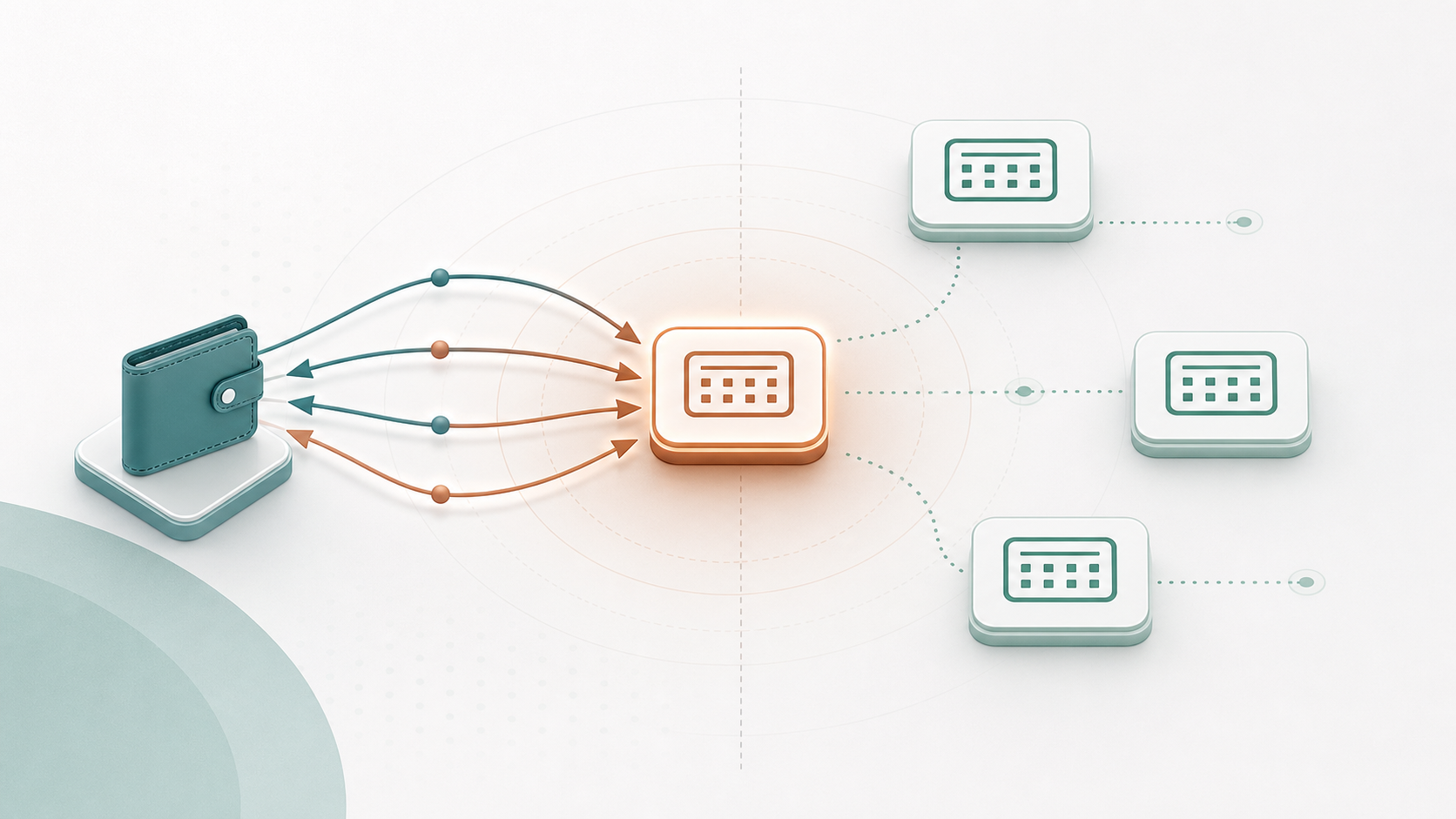
Wallet vs account vs address in crypto is confusing because wallet apps use the words differently. The short version is: a wallet is usually the app, device, or key container you use to manage crypto; an account is a grouping or onchain entity inside that wallet; and an address is a public network identifier used to receive funds or identify activity.
Those definitions are simple, but the details change by chain and wallet. One wallet can control many accounts. One account may have one address, or it may have many addresses across networks or over time. A new receive address does not automatically mean you created a new wallet, a separate balance, or a private identity.
The Short Answer
A crypto wallet is the tool you use to access and manage crypto. It may be a phone app, browser extension, desktop app, hardware device, or a key-management structure behind those interfaces.
A crypto account is a grouping inside a wallet, or an onchain account depending on the chain. In Ethereum, an account is an entity that can hold ETH or tokens, send transactions, and interact with smart contracts. In a wallet interface, an account may be a named profile such as "Account 1" that helps organize one or more addresses.
A crypto address is the public identifier used on a network. It is what someone copies when they want to receive funds, or what a block explorer uses to show visible activity for that address.
The privacy lesson is practical: treat addresses as public identifiers, not secrets. They do not reveal your private key, but they can reveal public blockchain activity tied to that address.
Why The Terms Are Confusing
The words are confusing because they come from several layers at once. A wallet app has its own interface. A blockchain has its own account or transaction model. A recovery phrase or seed can generate many keys. A user sees one screen and understandably expects one simple definition.
Wallet companies also choose labels for usability. One app might say "wallet" when it means the whole key source. Another might say "account" when it means a single Ethereum-style address. A multichain wallet might group one Ethereum address, one Solana address, and one Bitcoin address under a single account label because that feels simpler for the user.
That does not mean the words are meaningless. It means you should read them in context. Ask three questions: what app am I using, what network am I on, and which public address will other people see?
What A Crypto Wallet Is
A wallet is usually the app, interface, device, or key container you use to control crypto accounts and addresses. It is not the coins themselves. The assets are represented by records on a blockchain or network; the wallet helps you view and authorize activity.
People use "wallet" casually in several ways. They may mean the browser extension, the hardware device, the mobile app, the recovery phrase, or the whole collection of accounts they see after opening the app. For beginner privacy, the important point is that a wallet can manage more than one public identifier.
MetaMask's multichain account documentation gives one useful example. It describes a wallet as a cluster of accounts governed by a source of keys, such as a Secret Recovery Phrase, imported private key, or snap. That is MetaMask's current wallet model, not a universal law for every wallet, but it helps show why "wallet" often means more than one address.
The wallet is also where privacy mistakes can become easier or harder. A clear wallet interface can help you name accounts, choose the right receive address, and avoid mixing unrelated contexts. A confusing wallet interface can make every account and address look interchangeable.
What A Crypto Account Is
A crypto account is the trickiest word because it changes meaning across ecosystems.
On Ethereum, an account is an onchain entity. Ethereum.org describes Ethereum accounts as entities with ETH balances that can send messages on Ethereum. There are externally owned accounts, controlled by private keys, and contract accounts, controlled by smart contract code. Both can receive, hold, and send ETH or tokens and interact with smart contracts.
In a wallet app, though, an account may be a user-facing grouping. MetaMask's multichain model describes an account as a collection of addresses from different networks within a wallet. Under that model, one visible account can contain different network-specific addresses.
Bitcoin-style wallets can use the word differently again. A wallet may show one account-like experience while generating many receive addresses and change addresses underneath. In a derivation-path model, "account" can also refer to a specific level in the wallet's key tree.
For normal users, the safest rule is: an account is a context inside the wallet, but its exact technical meaning depends on the chain and app. Before reusing an account everywhere, check what public address or address set other people will be able to inspect.
What A Crypto Address Is
A crypto address is a public identifier on a specific network. It is used to receive assets, identify an account, or show activity on a block explorer.
On Ethereum, an externally owned account has a public 0x... address. That
address is derived from the account's public key, while the private key is what
controls the account. You can share an address to receive funds. You should
never share a private key or recovery phrase.
On Bitcoin, receive addresses are also public identifiers, but Bitcoin-style wallets commonly generate fresh receive addresses for new payments. Bitcoin Core's app design docs describe receive addresses as addresses users share with someone who will send a payment, and fresh receive addresses as a best practice for onchain privacy.
An address being public does not mean it is harmless to reuse everywhere. A public address may be safe to share for receiving funds in the narrow security sense that it does not expose your private key. But once the address is used, public transaction history around it can become visible and easier to connect.
How Bitcoin-Style Wallets Can Use Many Receive Addresses
Bitcoin-style wallets often use many addresses inside one wallet. That is normal.
A wallet may show you a fresh receive address after each payment request. The new address can still belong to the same wallet. It does not necessarily mean a new wallet was created, and it does not mean your old address disappeared. It usually means the wallet is trying to avoid turning one address into the label for every payment you receive.
This matters because Bitcoin transactions are public, traceable, and permanently stored on the network. Bitcoin.org recommends using a new Bitcoin address each time you receive a payment because a used address becomes associated with public transaction history.
Bitcoin-style wallets can also use change addresses. If you spend from a set of Bitcoin outputs, the wallet may send the leftover amount back to a change address it controls. Many wallet apps hide this detail from users because it is easy to misunderstand, but it is one reason a wallet can manage more addresses than you manually copied.
Fresh addresses have limits. They reduce simple address reuse, but they do not make Bitcoin anonymous. Later spending behavior, offchain records, counterparties, exchange data, public posts, and wallet-server design can still create links.
How Ethereum-Style Accounts Feel Different
Ethereum-style accounts usually feel more stable to the user. A wallet account
often has one visible 0x... address that receives assets, sends
transactions, connects to apps, holds tokens, and interacts with smart
contracts.
That makes the account easy to use, but it also makes it easy to turn one address into a public profile. If the same account is used for donations, trading, NFTs, app testing, public posts, client payments, and personal transfers, those activities can become easier to inspect together.
This does not mean every Ethereum user needs many accounts. It means account separation can be useful when contexts are genuinely different. One account for public donations and another for personal app activity does not create anonymity. It simply avoids making one address the obvious meeting point for every context.
Multichain wallets add another wrinkle. In MetaMask's current multichain model, one account can contain multiple network-specific addresses. That may be easier to manage, but it also means users should pay attention to which network address they are copying or connecting.
Why This Matters For Privacy
Wallet, account, and address terminology matters because public blockchains are inspectable. A public address can reveal visible balances, incoming and outgoing transfers, token holdings, contract interactions, timing patterns, or relationships depending on the chain and explorer.
If you publish one address on a profile and then reuse it everywhere, you have made that address a public label. Anyone who knows the address may be able to look up activity tied to it. If you use one Ethereum account with every app, that account can become an easy place to inspect your public onchain behavior. If you reuse one Bitcoin receive address, separate payments can become easier to connect.
Good wallet hygiene is mostly about avoiding unnecessary linking. Use fresh receive addresses where your wallet and chain are designed for that. Use separate accounts or wallets for separate contexts when the extra complexity is worth it. Name accounts clearly so you do not accidentally use a public-facing address for a private context later.
The limit should stay attached to the habit: these steps reduce avoidable exposure. They do not erase old links, hide activity from services you used, remove obligations, or guarantee that no one can infer relationships from later activity.
Practical Mistakes To Avoid
Do not assume a new receive address means a new wallet. In Bitcoin-style wallets, fresh receive addresses can be normal wallet behavior.
Do not assume every chain rotates addresses the same way. Bitcoin-style UTXO wallets and Ethereum-style account wallets have different user experiences.
Do not post one public address everywhere unless you are comfortable with its visible history being easy to inspect.
Do not treat a public address like a private key. A public address can be shared to receive funds; a private key or recovery phrase should not be shared.
Do not rely on fresh addresses alone as a privacy guarantee. Fresh addresses help with one kind of linkability, but they do not make public-chain activity invisible.
Do not leave every account named "Account 1" if labels would help you avoid mixing contexts. Labels do not change the blockchain, but they can prevent future mistakes.
FAQ
Is a crypto wallet the same as an address?
No. A wallet is the tool or key container used to manage crypto. An address is a public identifier on a network. One wallet can control many addresses.
Is a crypto account the same as a wallet?
Not usually. A wallet can contain or manage accounts. On Ethereum, an account is an onchain entity. In wallet apps, an account may be a user-facing grouping. The exact meaning depends on the chain and app.
Does a new receive address mean a new wallet?
No. In Bitcoin-style wallets, a fresh receive address can still belong to the same wallet. It is often a privacy habit that avoids reusing one public identifier for every payment.
Why does Bitcoin use so many addresses?
Bitcoin-style wallets commonly use fresh receive addresses and hidden change addresses. This helps avoid simple address reuse, but it does not make Bitcoin transactions anonymous.
Why does my Ethereum wallet usually show one 0x... address?
Ethereum-style accounts usually center activity around a public account address. That address can receive assets, send transactions, hold tokens, and interact with smart contracts.
Can people see my balance from my address?
Often, yes, depending on the chain and explorer. A public address can show visible blockchain activity associated with that address. It does not reveal your private key, but it may reveal more activity than you expect.
Does using a new address make crypto anonymous?
No. A new address can reduce simple address reuse, especially in Bitcoin-style receiving flows. It does not erase public history, hide offchain records, or guarantee anonymity.
Should I label my wallet accounts?
Yes, if your wallet supports it. Labels help you remember which account or address belongs to which context. That can reduce accidental reuse or accidental mixing of public and personal activity.
Related Reading
- Why Does My Crypto Wallet Generate A New Address?
- Privacy By Default In Crypto Wallets
- What Is Address Reuse?
- Can People See My Crypto Wallet Balance?
- What Information Is Public On A Blockchain?
- Crypto Wallet Privacy Checklist
Summary
A wallet, account, and address are related, but they are not the same thing. A wallet is the app, device, interface, or key container. An account is an onchain entity or wallet grouping, depending on the chain and wallet. An address is the public identifier other people and block explorers can see.
The practical rule is simple: understand which public address you are using before you reuse it. Fresh Bitcoin-style receive addresses, separate Ethereum-style accounts, and clear labels can reduce avoidable linking, but none of them make crypto anonymous or remove public-chain history.
Sources
- MetaMask Support: Multichain Accounts Guide: https://support.metamask.io/configure/accounts/multichain-accounts
- Ethereum.org: Ethereum Accounts: https://ethereum.org/developers/docs/accounts/
- Ledger: Understanding Crypto Addresses And Derivation Paths: https://www.ledger.com/blog/understanding-crypto-addresses-and-derivation-paths
- Bitcoin Core App Design Docs: Addresses: https://bitcoincore.app/addresses/
- Bitcoin.org: Protect Your Privacy: https://bitcoin.org/en/protect-your-privacy
- Bitcoin Security Guide: Privacy: https://bitcoinsecurity.org/guide/privacy/
- Bitcoin Core Features: Privacy: https://bitcoin.org/en/bitcoin-core/features/privacy