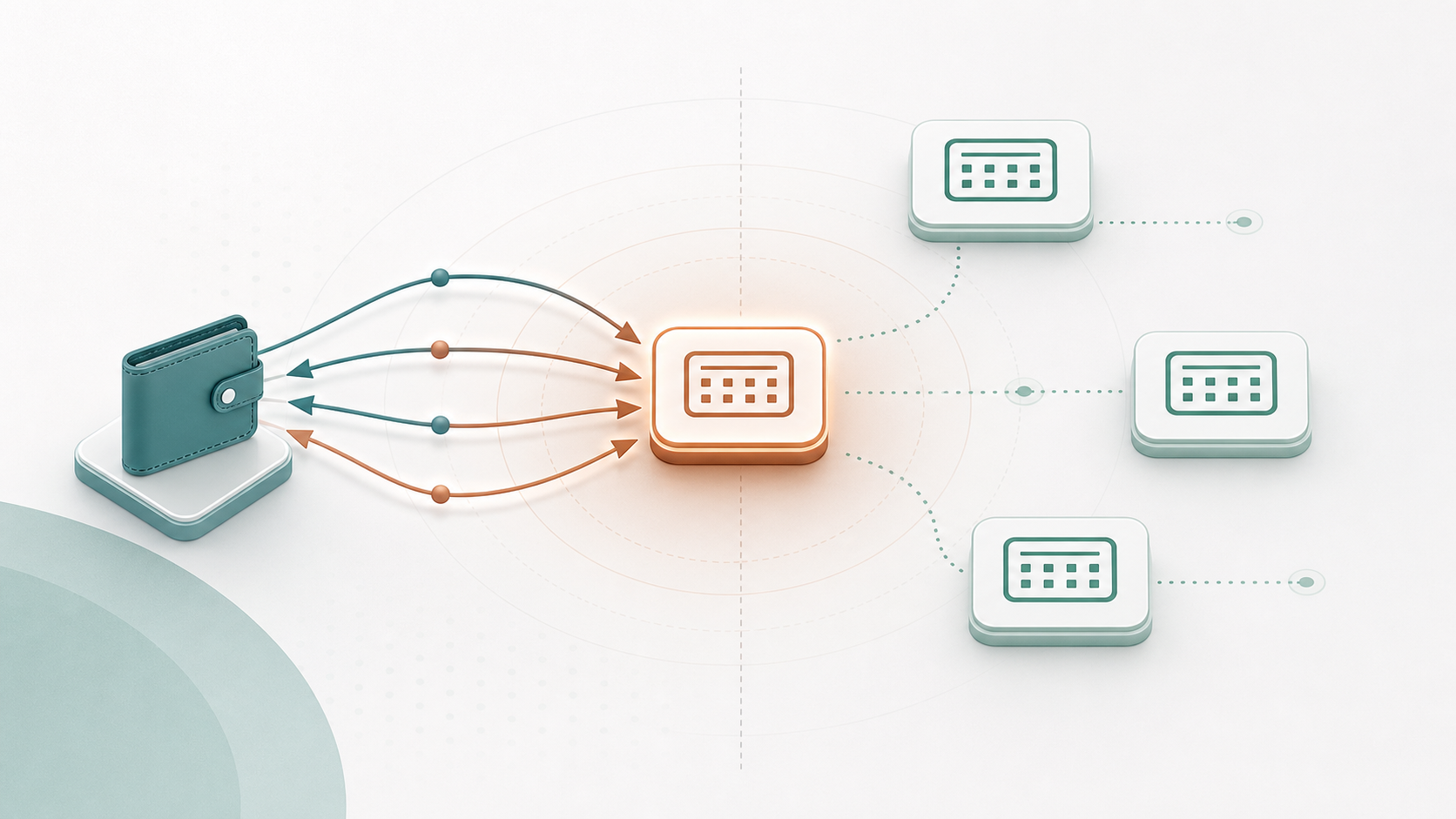
Wallet clustering is the practice of grouping crypto addresses or wallet activity that may belong to the same person, wallet, service, or entity.
The important word is "may." Clustering is usually based on public blockchain data, repeated patterns, and heuristics. It can suggest that activity is related, but it is not the same thing as proving a real-world identity.
The Short Version
Wallet clustering tries to answer a simple question: do these addresses or transactions look connected?
On public blockchains, addresses and transactions can often be inspected by anyone. Analytics tools, researchers, investigators, businesses, and ordinary users can look for links between addresses. Sometimes the link is obvious, such as one address being reused in many places. Sometimes it is an inference, such as addresses being used together in a way that may suggest common control.
That makes clustering useful, but imperfect. A cluster can be a clue. It should not be treated as automatic identity detection.
Why Wallet Clustering Exists
Public blockchains are built to make transactions verifiable. That visibility is part of the system's design, but it also creates a public data trail.
If a wallet address appears on a donation page, receives funds from a known counterparty, interacts with a public app, and later moves funds through other addresses, those events may create links. Some links are direct facts from the chain. Others depend on interpretation.
Blockchain analytics vendors describe clustering as part of a broader process of looking at transaction graphs, addresses, and attribution data. Academic work on Bitcoin has also studied how shared-ownership heuristics and address reuse can connect pseudonymous activity. The practical point for normal users is simple: public activity can become more connected over time.
A Simple Example: Address Reuse
Imagine you use one address for three unrelated things:
- a public donation page,
- a client invoice,
- and a personal transfer from a friend.
Each person may only know about their own payment. But if they look up the address, they may see the same public history. The donation page, invoice, and personal transfer now point at one visible address.
That is a basic form of clustering. The address becomes a hub that connects separate contexts. No advanced analysis is needed; the user created the link by reusing the same public identifier.
Common High-Level Signals
Wallet clustering can use many kinds of signals. The details vary by chain, tool, and dataset, but the broad categories are easy to understand.
Address reuse is one signal. If the same address keeps appearing across payments, apps, public profiles, and counterparties, it becomes easier to treat that address as one visible activity trail.
Co-spending is another signal, especially in Bitcoin-style systems. The common-input-ownership heuristic assumes that inputs spent together in one transaction are controlled by the same entity. The Bitcoin Wiki describes this as a heuristic, meaning it is an assumption rather than a rule.
Transaction-graph links can also matter. Bitcoin Optech discusses output linking as a privacy issue where later spending patterns may connect activity that once looked separate.
Offchain context can strengthen a cluster. A public post, exchange record, invoice, profile name, domain, screenshot, or app account can attach meaning to an address. Once that context exists, the visible chain activity becomes easier to interpret.
Why Clustering Can Be Wrong
Clustering is probabilistic. It can suggest relationships, but it can also make mistakes.
Some addresses belong to services rather than one person. Exchanges, custodians, payment processors, bridges, and apps may hold or move funds for many users. A transaction involving one of those services does not automatically mean all nearby activity belongs to the same person.
Some wallet behavior can also confuse simple assumptions. A heuristic might work well in many ordinary cases and still fail in edge cases. That is why careful analysis uses caveats, confidence levels, and supporting evidence instead of treating one pattern as proof.
For readers, the lesson is not "analytics is fake." It is that analytics is not automatic identity proof. A cluster may be useful, but it can still be incomplete, stale, or wrong.
How Users Accidentally Strengthen Clusters
Most people do not create clusters on purpose. They create them through convenience.
They reuse an address because it is easy to copy. They connect the same wallet to many apps. They use one account for personal payments, trading, public profiles, testing, and work. They post an address publicly, then later use it for unrelated activity. They combine funds from separate contexts in a later transaction.
Each action may feel small. Together, they can make a wallet easier to group, inspect, or explain.
Responsible Privacy Hygiene
Good wallet hygiene is about reducing unnecessary linkability. It is not about promising anonymity or hiding from obligations.
Use separate wallets or accounts for separate purposes where your chain and wallet make that practical. Avoid publishing a private-use wallet address. For Bitcoin-style receiving flows, follow the wallet's fresh-address flow instead of using one long-term receiving address for everything. Be careful about connecting your main wallet to every app you try.
Also remember the limits. Better hygiene does not erase old public links, hide activity from services you used, remove legal or tax obligations, or guarantee that nobody can infer relationships from later activity. It only reduces some avoidable exposure.
FAQ
What does wallet clustering mean?
Wallet clustering means grouping addresses or activity that may be related. The grouping is usually based on public blockchain data, heuristics, patterns, and sometimes offchain context.
Is wallet clustering proof of identity?
No. Wallet clustering can suggest that addresses or transactions are connected, but it does not automatically prove who controls them in the real world.
What is the common-input-ownership heuristic?
It is a Bitcoin-related heuristic that assumes inputs spent together in one transaction are controlled by the same entity. It is useful as a concept, but it is still a heuristic, not a guarantee.
Does address reuse make clustering easier?
Yes. Reusing the same public address can make separate payments, apps, profiles, and counterparties easier to connect.
Can I prevent all clustering?
No privacy habit can guarantee that. You can reduce obvious links, but public blockchain data, app metadata, counterparties, services, and later wallet behavior can still create connections.
Summary
Wallet clustering is a way to group addresses or activity that may be related. It is useful because public blockchains expose transaction data, and users often create visible links through address reuse, repeated wallet use, and offchain context.
But clustering is not automatic identity proof. It relies on signals and assumptions that can be strong, weak, or wrong. The practical privacy lesson is to avoid turning one wallet into your whole public life, keep contexts separate where possible, and treat public-chain activity as public by default.
Sources
- Bitcoin Wiki: Common-input-ownership heuristic: https://en.bitcoin.it/wiki/Common-input-ownership_heuristic
- Bitcoin.org: Protect Your Privacy: https://bitcoin.org/en/protect-your-privacy
- Bitcoin Optech: Output Linking: https://bitcoinops.org/en/topics/output-linking/
- Chainalysis: Blockchain Analytics: https://www.chainalysis.com/glossary/blockchain-analytics/
- TRM Labs: The Fundamentals Of Cryptocurrency Transaction Tracing: https://www.trmlabs.com/resources/blog/the-fundamentals-of-cryptocurrency-transaction-tracing
- USENIX ;login:: A Fistful Of Bitcoins: https://www.usenix.org/publications/login/december-2013-volume-38-number-6/fistful-bitcoins-characterizing-payments-among
- arXiv: The Unreasonable Effectiveness Of Address Clustering: https://arxiv.org/abs/1605.06369
- arXiv: Assessing The Efficacy Of Heuristic-Based Address Clustering For Bitcoin: https://arxiv.org/abs/2403.00523
Editor Note
Reviewed 2026-06-09 by Sofia. Replaced generic "magic" phrasing with clearer caveats, preserved heuristic limits, and kept clustering claims tied to listed sources. No new verification TODOs added.